Tuesday, May 31, 2016

Kitten Season

We're coming up on what is commonly known as "kitten season".  That time of year when kittens start streaming in from people who have found them under their porches, on their farms, or in an old shed.  They come in for the most part without a mother, some too young to eat on their own, and others a bit older and showing signs of becoming feral. 

These kittens typically end up on a foster home.  The very young ones will be fed by bottle and pottied by hand.  The older ones will be handled, played with and hopefully learn that living with humans is not such a bad thing after all.  Many times they come out of their shell and become more social. 
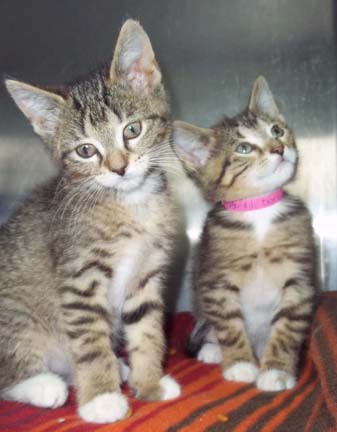
When I first started working at HAWS 12 years ago kitten season came rushing in with baskets, boxes and carriers of kittens coming through the doors starting in March and running right through until the end of October -- sometimes even later.  Then most of our cat adoption ward was filled with cages upon cages of 8 week old kittens.  And even though the little ones were adopted quickly, there was a never ending stream to take their place. 

We've noticed a huge change in the last few years.  Kitten season has started with a trickle, and doesn't really get going until the middle of June.  The students in my education programs during the school year repeatedly ask to see kittens, and it's rare that I have any to show them in the spring.  And while our cat adoption ward has many cages of kittens at the height of kitten season, it's not nearly to the level that it was years ago. 

I give credit to HAWS for this transformation.  Our spay and neuter clinic offers free spay/neuter to farms with barn cats, and to residents taking care of community cats; the cats that have no owners. We've also created alliances with other organizations to take cats if we are over-full and they are able. 

HAWS has a goal to create a no-kill community.  Right now we fulfilling that definition with dogs and our small animals.  And we are ever so much closer to that goal with the cats that we take in; we get closer every year.   Spay and neuter to reduce the population works, and HAWS is proof of that. 

Friday, April 29, 2016

Hee Haw!

Where do donkeys go when they've been neglected, mistreated, or no longer wanted?  Luckily there are non-profit rescue organizations that are able to take these animals in and care for them either for life, or until they've been adopted into their own homes. 

Holyland Donkey Haven in Mt. Calvery, WI is one such place, and this semester's group of Critter Club members was lucky enough to be able to visit there last Sunday on our regular semester field trip. 

Donkey Haven founder, Angela Langoski could not have been more welcoming to our group as she explained about how she started rescuing donkeys and created a sanctuary.  

We heard personal stories about some of the donkeys -- both sad stories about their past, and happy stories about how they went to their loving new homes.  

Much like HAWS, Donkey Haven is a private non-profit that relies on donations and volunteers to care for the animals and ensure that they will always have a safe place to live. 

Critter Club members all fell in love with these wonderful animals and were astounded at how affectionate, gentle and playful they could be.  We all laughed to see them rolling around on their backs in the dirt, and moved out of the way when they got a bit frisky.  


There were a lot of requests to take one home, but unfortunately getting one on the school bus would have been a logistical problem.  We reluctantly left the donkeys behind with promises to visit again.   

Monday, April 18, 2016

Thanks!

A few weeks ago I was a presenter at a High Interest Day held at Rose Glen Elementary.  Mystic and I spent a morning teaching three different groups of children about training animals, which is one of my favorite topics.  Part of the presentation was a demonstration of Mystic learning something new, and then showing off all his tricks.

Earlier this week I received a large envelope filled with wonderful letters and drawings thanking me for my visit at the school.  There is nothing better for someone who works with kids than to get letters and drawings of appreciation!

I wish I could post all of them, but there are just too many.  Here are some of my favorites!


Thursday, March 31, 2016

It's that time of year!


Things are warming up, we're getting rain instead of snow, buds are forming on trees and grass is getting greener.  In addition to life becoming more enjoyable to us humans, it's also the time of year that HAWS sees a huge increase in the number of wildlife being brought into our shelter.

These animals typically are injured, sick or thought to be orphaned, and will be transferred to a wildlife rehabilitation center until they can be released back into the wild where they belong. I use the term "thought to be orphaned" because many times baby animals are removed when they should not have been.

http://www.2ndchance.info/bunnynest.jpgBaby rabbits and fawns in particular are misunderstood.  A concerned citizen sees them without an adult and assumes that they've been abandoned by their parents.  What many people don't realize is that these prey species absent themselves from their babies deliberately.  Hanging around where your baby is located is a good way to tell a predator where to find an easy meal.  The mother rabbit and deer come back  to feed their babies, and then leave again. 

If you are convinced that a nest of rabbits has been abandoned you can lightly cover them with grass and check on them the next morning.  If the grass has been removed the mother rabbit has been by for a feeding.

A fawn will only require assistance if it has been crying for more than 3 hours, or if it is obviously injured.  Observe from a distance - getting too close means that you're spreading your scent in the area of the baby deer and your scent may attract predators.

If you want to help a wild animal you should first find out if it actually  needs help and what kind of help it needs.  A great resource is the Wildlife In Need Center in Dousman.  They have a great FAQ section on their website, or you can call during their clinic hours with questions.

Friday, February 19, 2016

How Long?

"How long did it take you to train him?"

That's a question I hear quite often as Mystic and I do our education programs and he shows off the tricks and manners that he knows.  And it's a question that I'm never really sure how to answer because it's a question that has many answers.

Mystic knows a lot of behaviors.  He started learning stuff at the age of 9 weeks when he first came to me.  But I didn't barrage him with learning new things all at once; a lot of the things Mystic knows were introduced over a period of several years.  As a matter of fact I still sometimes teach him new things.  So does that question mean all the behaviors he knows?  If so the answer is 11 years (his age), although that might make him sound as though he isn't very bright, and Mystic is very smart. 

Mystic learns quickly, but like any individual he picks up on some things faster than others.  His "wave" trick was extremely easy for him to learn because he tends to use his paws a lot.  "Say Your Prayers" on the other hand took many, many sessions of training.  So I could ask the person which trick or behavior they are asking about.

Another aspect to training is the different stages an animal goes through.  There's the initial teaching of what it is the trainer wants the animal to do, the training the animal to do it on cue, and then there's training the animal to do it in a variety of situations with a variety of distractions.  So does the question refer to learning the initial behavior, or getting Mystic to do it reliably no matter when I asked him to do it?

But what most people think is that training an animal is like putting siding on the house.  Once the siding is up it's pretty much maintenance free, and they think that once an animal is trained he's trained.  But training is actually more like learning a sport or musical instrument.  There's learning the skill, perfecting the skill, and keeping up on the skill.

Professional football players don't come back from their time off and play their first NFL game without practicing.  Skills get rusty over time if they aren't practiced and it doesn't matter if you're a human or an animal.

So Mystic might know a lot of stuff, but if I don't practice his skills he will noticeably deteriorate in his performance.  So doing training sessions to practice things he already knows helps keep his skills sharp.

So I guess the answer is still 11 years. 

Monday, January 25, 2016

Making Do with What You Have

When I was growing up I wasn't allowed to have a dog, though I dreamed about it and was one of those kids that got excited every time I saw a dog.  We had fish, turtles, at one time I had a garter snake, and then when I was in Junior High I was allowed to have a hamster.  I really wanted a "real pet" that I could do something with.  Something more than just holding it and (in the case of the hamster) petting it.

Now I have dogs and we do a lot together.  And because I really enjoy training dogs and have a vast network of friends (both real life and cyber) who are also training geeks I have access to more training information than I know what to do with. Additionally, when I was growing up we didn't have that wonderful thing called the internet -- which has allowed a great exchange of information and videos.

Some of the most amazing videos I've seen of trained animals haven't been with dogs, but with small pocket type animals.  The same animals that many kids are resigned to having in lieu of having a "real" pet like a cat or a dog. Who know that hamsters, guinea pigs and rats could learn so much and be so much fun?

If you have one of these types of pets watch the videos I've posted below and be inspired.  And if you don't, watch anyways and be in awe.


Wednesday, December 9, 2015

FBI and Animal Crimes

Some exciting changes are happening at the federal level with regards to crimes against animals.  The National Incident-Based Reporting System (NIBRS) maintained by the FBI is a database. "Law enforcement agencies collect detailed incident level data regarding individual offenses and arrests and submit them using prescribed data elements and data values." (FBI website)

Tracking crimes in detail allows law enforcement and other agencies/organizations to get statistics on specific crimes, the people committing the crimes, as well as statistics on victims and circumstances.  Participating law enforcement agencies report each crime occurence in a specific category with detailed information.

To date crimes against animals have been reported the general category "all other offenses" as class B offenses which collect data on arrests, not on other aspects of the crime.  Class B offenses are those crimes which aren't considered serious enough to track more specifically.

As of January 1, 2016 participating law enforcement agencies will have to report crimes against animals as a Class A offense with animal crimes having their own category.  (Huffington Post article has more information.) Data will be collected on four different subcategories: simple or gross neglect; intentional abuse and torture; organized abuse, including dogfighting and cockfighting; and animal sexual abuse.

This decision is a response to the massive amount of research that shows direct links between animal cruelty and an escalation towards violence towards people.  There is a strong correlation between children who abuse animals continuing to go on to be physically violent as well as other delinquent behavior in adolescence.  Additionally many serial killers and school shooters started practicing by abusing and torturing animals.  And animal abuse is strongly connected to domestic abuse. (See page on Michigan University's website for further information.)

The decision by the FBI to change how animal crimes are tracked does several things.  First of all it offers legitimacy to the idea that crimes against animals need to be taken seriously.   Many times cases involving animals end up being dismissed or the punishment being a very short jail sentence or only probation.  The FBI's decision to track illegal acts against animals sends a message that these crimes are something that society should be concerned about. And the tracking could make it easier to get better sentences and make an impact on juries. 

Furthermore it could potentially be a catalyst for education of the public as to why crimes against animals are so serious, and how offenders could go on to endanger other members of society.  People who are dismissive about animal welfare will care about other human beings.

Lastly the statistics will allow law enforcement to track the progression of these crimes, give information to school counselors and social workers as to what they can look for to identify children at risk of being abused, or who may be future abusers themselves.  Early intervention in the lives of these children could help to prevent future violence.