Friday, January 28, 2011

PETS Graduation


First semester of Lad Lake has come to an end, and so the boys that were participating in the PETS (Positive Empathy Training for Success) program graduated.

I am very proud at the end of each semester of how far the students have come. Not only have their training skills improved, but they have achieved personal growth as well.

One of the boys who tended to get frustrated and shut down in the beginning learned to become more patient and adapt if things didn't go the way he thought he should. Another went from being bossy with the other boys to becoming a true team member who could express himself without belittling. A third boy who used to run away from school when his emotions got the better of him, learned to control himself so that he could attend the program at HAWS.

Each semester I make a video for the boys comprised of the video and photos that were taken during their time here and add music. Because it's a gift for pre-teen and teenage boys, the music I use is for them. The boys get the video, as well as files containing photos and unedited video and a certificate of completion.

The video embedded here is an edited version of what I made for the boys.

Friday, January 21, 2011

I Know a Rooster When I Hear One

One of the most interesting parts about working in an animal shelter is that you never quite know what we have until you come into work.

As I was walking into the building from the parking lot one day last week I heard crowing. Yep -- HAWS had a rooster.

Apparently the lucky guy was originally slated to be someone's dinner. I don't know what the circumstances were, but he ended up at HAWS looking for a new home.

We're hoping to find a forever farm for him soon.

Another lucky animal was a cat that was found in an abandoned garage last night by a kind Waukesha County resident and brought into HAWS. The weather in Wisconsin right now is brutally cold -- it was -8 degrees when I got up this morning. The poor kitty was half frozen and luckily survived. Right now she's staying in a foster home while she recovers from her ordeal.

This serves as a good reminder to all of us who have pets that they really shouldn't be outside for any length of time. I know my dogs run out to eliminate and then want to come right back in.

Wednesday, January 5, 2011

A Really Wonderful Book

I've been giving a lot of thought to the "Smooch your Pooch" book and the blog post I did about it last month.

There are a lot of really great books for children that do a wonderful job helping children develop respect and empathy for pets, and learn how to appropriately interact with them.

Once of my favorites is a book called "Libby and the Cat" by Yetti Frenkel. The front cover illustration shows a little girl about to step on the tail of her cat. While this would make the book appear to be a poor choice as an appropriate pet friendly story for children, trust me when I say the book is wonderful. I love it so much that I gave it as a gift to my young nephew, and often read it on my visits to pre-school classrooms.

The story is about 3 year old Libby Bess who teases the family cat. She steps on his tail, dresses him up in hats, pushes him in a stroller, and sneaks up on him and scares him -- among other things.

One day she realizes that she doesn't like it when people force her to do things she doesn't want to do, and realizes that the cat probably doesn't either. At that point she starts to do things for the cat that she thinks he most likely enjoys -- likely playing with him with a catnip mouse string toy.

What's so wonderful about this book is that I think kids really can relate to this. Teasing other kids and animals can give children a sense of power that they might not be able to get any other way -- it can make them feel good. But realizing that others have feelings and our behavior can impact the emotions of others should be part of growing up to be an emotionally healthy person -- it should be the goal of any parent for their child. And this book can be a tool to help children with this important part of their development.

Thursday, December 30, 2010

Winter Camp is Here Again

It's that time of the year again - when the snow is on the ground, when it's gotten cold enough that you can see your breath, and when in Wisconsin in December it can get up into the 40's and drizzle. It's also the time of year when kids have a break from school and HAWS holds Winter Camp.

This year HAWS had two sessions of camp -- a two day session on Monday and Tuesday, and a three day session running Wednesday through Friday.


We've done a lot of the traditional activities that HAWS Winter Camp schedules such as making pine cone bird feeders for the kids to take home and put out for the wild birds, and learning about sled dogs and getting a dog sled ride curtesy of HAWS Executive Director Lynn Olenik and her huskys.

This year I added walking HAWS adoptable dogs to the camp scheduled. This is an activity that the summer campers partake in, but it's a first for our winter camp. I came to the realization that many dog owners don't have the option to skip exercising their dogs just because the weater is cold and snowy. And this is a lesson that I wanted the kids to learn as well.

This decision actually was a win-win for me personally. I'm fostering a dog for HAWS named Jenna. About a year old with more energy than I know what to do with, and with an obsession for chasing a ball, it made sense to have the kids help me tire her out.

Jenna is very obliging -- she really doesn't care who throws the ball as long as she can chase it. And it has been really nice to have the kids throw the ball -- it's allowing my developing tennis elbow to heal before camp ends and I have to go back to throwing the ball again.

Friday, December 17, 2010

(Don't) Smooch Your Pooch

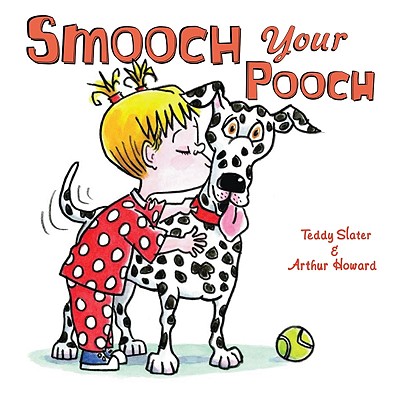
One of the newest children's book releases is entitled "Smooch Your Pooch" and has an illustration on the front cover of a little girl planting one on a dog's cheek. Amazon has some great reviews from parents who state that it's a cute story, has great rhymes, and their kids really love it.

It's also come on the radar of veterinarians, dog trainers and behaviorists, and the American Veterinary Society of Animal Behavior. The biggest problem are the pages that advise children to: "Smooch your pooch to show that you care. Give him a hug anytime, anywhere."

While these words sound innocuous enough to most people, to a professional in the world of canines they evoke horror. A display of affection by kissing and hugging is a part of what we humans do. But this kind of display can and does end up with children getting bit. When a dog puts his paw over the back of another dog it is not a friendly gesture. And many dogs do not like being restrained -- which is what a hug really is. Kissing can also bring problems since it usually places a child's face right next to a dog's teeth.

Yes -- I do hug and kiss my dogs all the time -- and they tolerate it because I am their human, and because I know when they are not in the mood for me to do it and want to be left alone. I think many dogs are the same way -- willing to tolerate the silliness of the people they live with. And I think it's unrealistic to expect people - especially children, to NOT ever display affection by hugging and kissing their dogs.

Dr. Sophia Yin wrote a really fantastic review of the book on Amazon detailing why this is an inappropriate book and I don't want to use my blog to re-write something that she already put so concisely. I'd rather address some of the reviews that were written after hers and those who concurred with her concerns.

Many of these reviewers stated that the book does not advocate that children go up to strange dogs and hug and kiss them, and so didn't see why the book was a problem. The problem is that children should be taught that even THEIR OWN dogs really don't like to be hugged and kissed, and that children should respect their own dog's feelings. The line, "Give him a hug, anytime anywhere" doesn't take into consideration the fact that no one wants a hug anytime, anywhere!

Additionally it's my thought that children who have extremely tolerant dogs at home are more likely to get bit by dogs in the homes of others. They many times have not been taught that not all dogs are as tolerant as their own, and that they need to behave differently around other dogs.

Some of the Amazon reviews stated that the book was a good opportunity for parents to have a discussion about appropriate interactions with dogs. The problem with this comment is that many adults don't understand dog behavior and don't realize what inappropriate human/dog behavior is.

A case in point is the reviewer who stated that the book "...does not encourage kids to kiss strange dogs or dangerous dogs." Another stated that "...adults can take proper precautions by explaining that it is not a good idea to hug or kiss any strange animals." In their minds the only dogs that would take offense to their children kissing or hugging them are dogs they don't know, or dangerous dogs. Would they be surprised if kids were bit hugging the neighbors dog? What about a dog owned by a relative that they visit frequently? Most kids are bit by dogs they know -- not by stray dogs.

When I do education programs on dog safety I hear many stories of people who have been bit by dogs. They aren't all children - one parent told me that she had been bit by a friend's dog when she went to hug it, and a child told me that his Mom had been bit by a dog after she hugged it -- no, it was not the same woman! And most of the children who get bit by dogs were attempting to hug them when it happened.

My last concern about this book is that it apparently does have cute illustrations and the rhyming makes it fun to read. Kids are so impressionable and if they enjoy the book may want to act it out -- with perhaps negative consequences.

Again -- I want to state that I do think it's unrealistic that people and their kids won't kiss and hug their own dogs. But children and their parents need to be educated that dogs really don't like this type of affection, and they need to respect their furry family member's feelings and keep that kind of affection to a minimum at times when the dog is in the mood for it. And this book really doesn't help them do that.

Friday, December 3, 2010

Pet Myth: Stray Animals

"He was too friendly to have been a stray."
"Stray animals are pets that don't have a home."

I've heard both these statements when people refer to stray animals. A lot of people think that the word "stray" is equivalent to "feral" - which refers to a domesticated animal that has reverted to wild behavior and is not tame to people. (The difference between "tame" and "domestic" is a whole other blog post!)

Many people don't understand that the word "stray" is used to define an animal that is "wandering at large without an owner" (per dictionary.com). It could be that the animal was abandoned by an owner who no longer wanted it. It could be that the animal never had a home - an example would be kittens born to a feral mother. But many strays are simply pets that got lost and have owners looking for them.

By Wisconsin State Law stray animals have to be held for 7 days and an effort to search for the owner is required. HAWS takes lost reports from owners of lost pets and keep them on file. It's amazing how many animals are taken in as strays and never reported missing -- It's about 40% for dogs, and 80% for cats!

We also check for ID tags and make an effort to follow through on the contact information. Unfortunately we sometimes take in animals that don't have current information -- if the number has been disconnected we have no way to track the owner.

We also check for a microchip -- which is a tiny computer chip about the size of a grain of rice that's been implanted in the back of the animal between the shoulder blades. An animal with a microchip can be scanned and the number can lead us back to the owner. Again - the registry needs current contact information in order for this to be useful.

If we can't find the owner and 7 days has passed without hearing for the owner the animal legally belongs to HAWS. Most animals who are healthy and non-aggressive go up for adoption. And most strays that we take in have obviously been in a home in their past since they are friendly to people, and some have been spayed or neutered.

Don't assume that "stray" means feral - many times it just means that the animal is a wonderful pet that just -- for whatever reason -- never found it's way home. One of my dogs was originally found as a stray -- I adopted Belle 14 years ago and couldn't ask for a sweeter girl.

Monday, November 22, 2010

I Could Never Work There

This is a sentence that those of use who work in animal welfare hear regularly when we tell others what it is we do for a living. I generally assume that people mean that it would be so heartbreaking and depressing trying to cope with the sad stories and outcomes, that they wouldn't be able to emotionally handle it.

It is true that it takes a certain personality type to be able to handle some of the things we see -- there are sad stories that we have to cope with. I don't think there's anyone working here at HAWS that hasn't cried over some of the animals that have come through our doors.

But I think what most people who speak this sentence are missing, is that we do it because we feel we truly can make a difference, and because the stories with happy endings far outweigh the sad stories.

We get to see lost animals reunited with worried owners frantic to find them. We see animals with injuries rehabilitated and adopted out to new homes. Animals up for adoption that get passed over for months on end finally find the perfect family.

Recently one animal was surrendered to HAWS that had most of the staff over the moon in love with her. Oscar was surrendered by the daughter of her owner -- a man who was experiencing medical problems and could no longer care for her or give her the time she deserved. Many of us don't have parrot experience, and were suprised at just how much a Cockatoo has to give. As we discovered just how special and affectionate she was, she spent less and less time her her cage. For over a week Oscar could be found snuggling with one of our staff either behind the front desk, or in someone's office.

Oscar liked to have her neck rubbed, and would push her head into your hands when she wanted to ask for it. She loved to sit on shoulders, but even better was if someone was sitting down she'd sit on your lap and lean into your body. Oscar was all about the snuggling.

Although some of us had fantasized about keeping Oscar as an official HAWS mascot, we realized it wouldn't be the right thing for her. She really needed a home without the activity level of our shelter, and without the sounds of crowds on the weekends, and dogs barking. Because we were so taken with her, and because we knew that she required an adopter who understood parrots and how much attention they needed, we were looking for very special people. And we found them. Oscar's new owners has recently lost their Amazon Parrot to cancer and were ready for a new feathered friend. Their vet gave them an extremely high reference, and Oscar really seemed to like them.

We said goodbye to Oscar last week -- happy that she had the perfect home, and knowing that she was making two people very happy as well. That's what working in animal welfare is all about.